A Thematic Synthesis of the Book of Daniel: Historical Foundations, Character Integrity, and Prophetic Framework
1. Introduction: The Multifaceted Nature of the Book of Daniel
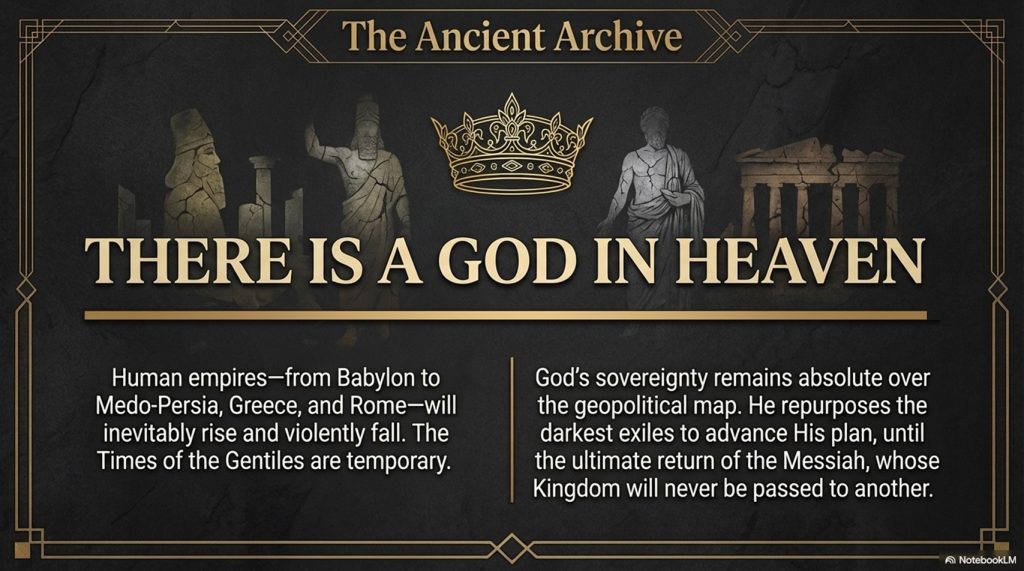
The Book of Daniel serves as a unique literary monument at the intersection of history, prophecy, and personal testimony. Within the biblical canon, it provides a panoramic “bird’s eye view” of world history, documenting the rise and fall of empires while asserting a singular, overarching theme: the absolute sovereignty of God. It demonstrates that the God of Israel “does as He wills in the kingdoms of men,” exercising authority over earthly powers until the eventual establishment of a Kingdom that shall never fail.
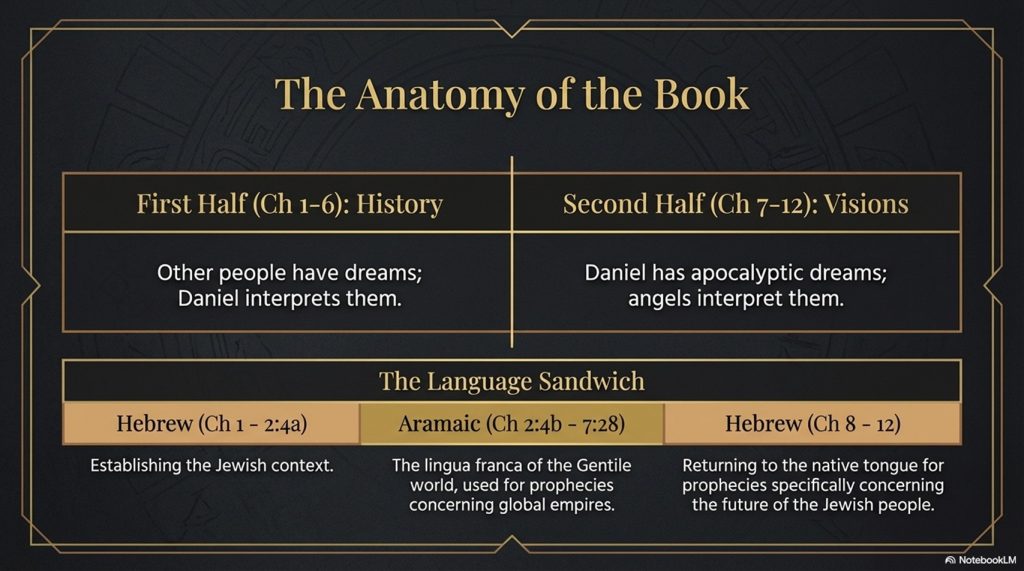
Structurally, the book is defined by a distinct dual nature that highlights Daniel’s progression from a gifted intermediary to a divine seer. The first six chapters are primarily historical, focusing on Daniel as an interpreter of the dreams and omens of foreign monarchs. In contrast, the final six chapters shift toward the apocalyptic, where Daniel himself receives visions from heavenly messengers that require celestial interpretation. This transition marks the move from the “Times of the Gentiles” being revealed through others to a direct unveiling of the future through the prophet himself. To fully appreciate this narrative, one must first navigate the chronological complexities and historical upheavals that initiated the Babylonian captivity.
2. Chronological and Historical Contextualization
Validating the biblical narrative against secular history requires a rigorous examination of the timing of the Judean exile. Precise dating is not merely an academic exercise; it is essential for reconciling the “70 years” of captivity mentioned by Jeremiah with the archaeological record of Babylonian and Persian decrees.
A critical framework for resolving these timelines is the “Two Periods of 70 Years” theory, championed by the 19th-century scholar Sir Robert Anderson in his seminal work, The Coming Prince. This perspective posits that the “servitude” of the nation and the “desolations” of Jerusalem are distinct but overlapping chronological blocks.
| Period | Start Date | End Event |
| The Servitude | 606 BC (Nebuchadnezzar’s first invasion) | 536 BC (Decree of Cyrus the Great) |
| The Desolations of Jerusalem | 586 BC (Destruction of the Temple) | 517 BC (Second year of Darius I, 19 years after Cyrus) |
Historically, Judah was caught in a geopolitical “Hammer and Anvil” situation, squeezed between the waning power of Egypt under Pharaoh Neco and the rising Neo-Babylonian Empire. King Josiah’s strategic alignment—choosing to side with Babylon to prevent Egyptian hegemony—led to his death at Megiddo. His successor, Jehoiakim, was eventually forced into vassalage when Nebuchadnezzar crushed the Egyptian forces at the Battle of Carchemish in 605 BC. It was during these macro-historical shifts that Daniel, a member of the Judean nobility, was transitioned from a life of privilege in Jerusalem to the status of a captive in a foreign court.
3. The Character of Daniel: A Study in Integrity and Excellence
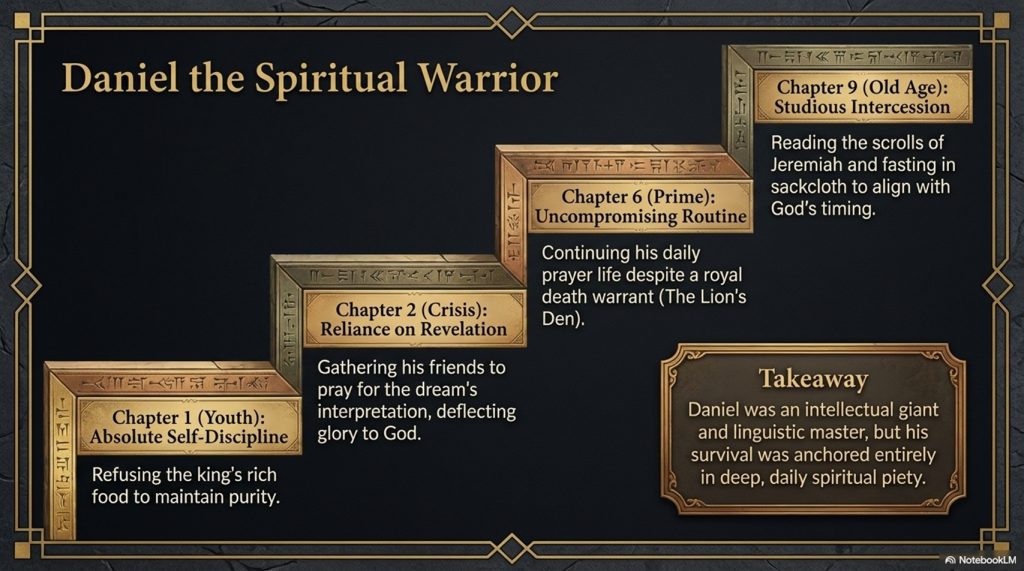
Daniel serves as a strategic model for professional and spiritual conduct within a hostile, pluralistic environment. His life demonstrates how a believer can maintain personal devotion while achieving the highest levels of executive excellence in a secular state. The parallels between the lives of Daniel and Joseph are profound, suggesting a divine pattern for those “sown” into foreign nations for God’s purposes:
- Youthful Exile: Both were taken from their homes as teenagers.
- Interpretation of dreams and Revelation: Both rose to prominence by interpreting the dreams of pagan rulers.
- Executive Promotion: Both achieved high administrative offices in world-class empires.
- Preservation: Both were instrumental in preserving their respective secular societies through wise administration.
The “Excellent Spirit” attributed to Daniel refers to a combination of high intelligence, self-discipline, and a robust prayer life. He faced a systematic attempt at ontological identity theft by the Babylonians, who sought to rebrand him through cultural assimilation. This included his probable castration—as he was placed under the “master of the eunuchs”—and a name change from Daniel (“God is my judge”) to Belteshazzar (“Bel protect the king”). While the name intended to honour a Babylonian deity, Daniel repurposed his role to protect the reputation of the true King. His refusal to eat the king’s meat was a refusal to succumb to cultural brainwashing. This integrity allowed him to serve four different foreign monarchs with such transparency that his enemies could only find fault in his unswerving faithfulness to his God.
4. Literary Structure and Linguistic Shifts
The linguistic structure of the Book of Daniel reflects its intended audience and global message, bridging the gap between Prophetic and Apocalyptic literature. While traditional prophecy often focuses on a “call to repentance” regarding immediate historical sins, apocalyptic literature acts as an “unveiling” (Gr. apocalypsis), using symbolic imagery to reveal God’s ultimate plan for the end of history.
The book follows a distinctive Hebrew-Aramaic-Hebrew linguistic map:
- Chapter 1 (Hebrew): Introduces the setting and the Judean captives in the covenant language of Israel.
- Chapters 2:4b–7 (Aramaic): This section begins exactly when the Chaldeans address the King in the lingua franca of the ancient Near East. This linguistic shift is strategically placed because these chapters deal with the “Times of the Gentiles” and God’s dealings with global world empires.
- Chapters 8–12 (Hebrew): Focuses back on the specific future of the Judean people and the holy city, returning to the language of the covenant.
This linguistic universality supports the book’s claim to be a message for the nations, speaking to the Babylonians in their own tongue while preserving the specific promises of the restoration for the people of Israel.
5. Defence of Authenticity and Archaeological Corroboration
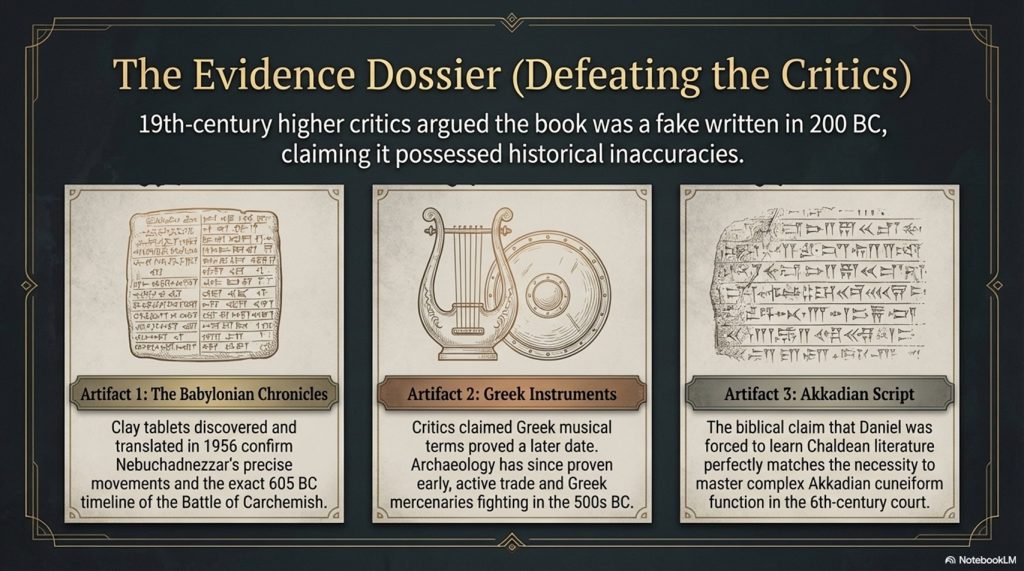
Defending the authenticity of Daniel is a strategic necessity against 19th-century “Higher Criticism.” Critics, such as those addressed in Sir Robert Anderson’s Daniel in the Critics’ Den, argued for a late dating (approx. 200 BC), claiming the prophecies of Daniel 11 were so accurate they must be vaticinium ex eventu (prophecy written after the event).
However, archaeological finds have consistently corroborated the traditional early dating:
- The Babylonian Chronicles: Published in 1956, these Akkadian cuneiform tablets provide a detailed account that aligns perfectly with the biblical record of Nebuchadnezzar’s campaigns.
- The Battle of Carchemish: Excavations at this site revealed vast quantities of arrowheads, layers of ash, and Greek mercenary shields. This proves that Greek trade and military contact were active in the 6th century BC, debunking the claim that Greek influence required a 2nd-century date.
- Linguistic Evidence: The discovery of Akkadian cuneiform tablets at Persepolis confirms the multi-lingual environment described in the book.
The accuracy of Daniel’s history is not a sign of late forgery but evidence of a contemporary eyewitness and the supernatural nature of his revelations, which include details about the 400 years of silence that were unknown to later critics but active in the divine plan.
6. Modern Relevance: Living in “Babylon” and Geopolitical Parallels
The life of Daniel remains a strategic manual for contemporary readers navigating societies that are often hostile to biblical values. His experience as an administrator in a godless state offers a blueprint for standing alone without becoming isolated.
Striking geopolitical parallels exist between Daniel’s visions and modern Middle Eastern tensions. The ancient rivalry between the “King of the North” and “King of the South” territories (encompassing modern Iraq, Syria, and Egypt) maps exactly onto the current Shia/Sunni split in Islam. Specifically, the “Twelver” theology of modern Iran (Persia) believes the 12th Mahdi will return during a period of global apocalypse. Unlike Sunni views, the Twelver mandate is to actively generate global turmoil to trigger this return. This religious-political syncretism finds a sobering backdrop in Daniel’s descriptions of end-time conflict.
To survive and thrive in a modern “Babylon,” three takeaways are critical:
- Maintain a Solid Foundation: Deep immersion in the Word of God is the only antidote to cultural “identity theft.” Like Daniel, one must know the Word well enough to recognize the shifting seasons of history.
- Repurpose Talents for the Kingdom: Believers should offer professional excellence for the benefit of their society, allowing God to repurpose their skills (e.g., Daniel’s wisdom in science and linguistics) to influence high-level secular environments.
- Humble National Identification: Daniel’s response to revelation was not pride, but sackcloth and ashes. He identified with the sins of his nation in deep repentance, showing that spiritual maturity is marked by a refusal to “fight” the captivity, but rather to pray and seek the peace of the city while awaiting God’s restoration.
Ultimately, the Book of Daniel serves as a reminder that while empires rise, fall, and “rebrand” themselves, the sovereignty of God remains the final reality of human history. Though we may live in a hostile environment, the God of heaven remains on His throne.