The Sovereignty of Time: An Analytical Commentary on the Prophetic Architecture of Daniel 9
1. Introduction: The Strategic Significance of the 70 Weeks
Daniel 9 represents the most critical junction in the biblical prophetic corpus, providing a mathematically rigorous framework for the redemption of Israel and the first advent of the Messiah. The historical context finds Daniel in the first year of Darius the Mede, meticulously calculating the conclusion of the 70-year Babylonian exile based on the writings of Jeremiah. However, as Daniel interceded with sackcloth and ashes, the angelic visitation of Gabriel dramatically expanded the horizon of his understanding. Gabriel’s revelation shifted the focus from a localized restoration to a grand 490-year (70 weeks) prophetic architecture. This expansion is rooted in the “Seven Times” logic of Leviticus 26; because the nation had failed to repent during the 70-year discipline, the final redemption would be delayed sevenfold (70 years x 7 = 490 years).
This revelation underscores the theme of history as the product of a “Master Architect.” It serves as an authoritative declaration that human history is not a series of random, chaotic collisions, but a precise, divine blueprint. This 490-year horizon provides the structural skeleton upon which the entirety of redemptive history is hung. By transitioning from Daniel’s immediate concerns regarding the Babylonian return to the ultimate Messianic restoration, Gabriel establishes a template that challenges the reader to look beyond near-term “hills” to the distant peaks of the Kingdom.
2. The Hermeneutical Divide: Preterism vs. Futurism
The interpretation of Daniel 9 remains a primary theological battleground, largely because one’s eschatological starting point dictates the reading of the text. The fundamental conflict centres on whether God maintains a distinct, future purpose for the nation of Israel. In contemporary scholarship, particularly within the UK church context, a widespread denial of Israel’s prophetic future has led to interpretative frameworks that attempt to force the entirety of the 70-weeks prophecy into the past.
Comparative Interpretative Schools
| Interpretative School | Primary Argument | View of Israel’s Prophetic Future |
| Preterism | The 70 weeks were “already fulfilled” by AD 70. This view is notably prevalent in the UK church context, where traditional covenant theology often replaces national Israel with the Church. | Sees no remaining distinct prophetic timeline for national Israel; the redemptive story for the nation is considered concluded and superseded. |
| Futurism / Dispensationalism | The first 69 weeks are historical, but a “prophetic gap” exists before the final 7-year period (the 70th week), which constitutes the future Tribulation. | God maintains a distinct, irrevocable purpose for the nation of Israel, leading to its eventual national conversion and restoration. |
The impact of these views on the “completion” of the redemptive story is profound. Preterism must gloss over the fact that the prophecy concludes with an “abomination of desolation,” while Futurism recognizes this as a “cliffhanger” that necessitates a final resolution. The latter view maintains that while the foundation of redemption was laid at the Cross, the geopolitical and physical restoration of the Kingdom remains a “fixed” decree yet to be realized.
3. The Six-Fold Mandate: Objectives of the Prophetic Decree
Daniel 9:24 serves as the strategic “mission statement” for the 490-year decree. It outlines six specific objectives that must be finalized before the prophetic clock reaches its conclusion. These mandates can be divided into two groups of three, representing the duality of the Messiah’s mission.
Foundational Accomplishments (The Cross) The first three objectives—to finish the transgression, to make an end of sins, and to make reconciliation for iniquity—deal with the legal and judicial reality of the human condition. From a scholarly perspective, these were spiritually established and finalized at the Cross of Christ. While sin remains present in the world, the judicial basis for its removal was secured through the Messiah’s “cutting off.” These foundational works provide the necessary spiritual platform upon which the subsequent physical restoration is built.
Consummation Objectives (The Kingdom) The final three objectives—to bring in everlasting righteousness, to seal up vision and prophecy, and to anoint the most holy—point toward the physical and geopolitical restoration of the Millennial Kingdom. “Bringing in everlasting righteousness” implies the actual reign of Christ on earth, while “sealing up vision and prophecy” suggests the point where all prophetic utterances are fully authenticated through total fulfilment. Whether “anointing the most holy” refers to the consecration of the Millennial Temple or the final installation of the Messiah in His Davidic throne, it clearly speaks of a post-desolation reality.
This prophecy essentially ends on a “cliffhanger of desolation.” Because the chapter concludes with the “pouring out” of judgment, it logically necessitates a subsequent era where these six mandates are fully realized in the sight of the nations.
4. The Chronology of Redemption: The 69-Week Countdown
The validity of Daniel 9 rests upon its mathematical precision, which is triggered by the “going forth of the command to restore and build Jerusalem.” Determining the correct “starting line” is essential for validating the prophecy’s historical accuracy and understanding the “Law of Double Reference”—where the prophet sees the near-term rebuilding of the city and the long-term arrival of the King in the same line of sight.
While various decrees are cited (Cyrus in 538 BC, Darius in 517 BC, or Artaxerxes’ first decree in 458 BC), these focused primarily on the Temple or safe passage. Only the second decree of Artaxerxes (recorded in Nehemiah 2), dated to March 5, 444 BC (or 445 BC according to Anderson’s earlier calculations), specifically authorizes the rebuilding of the city streets and walls. This “starting line” leads to an impossibly precise calculation using the Shabuar (units of seven years) and the 360-day prophetic year:
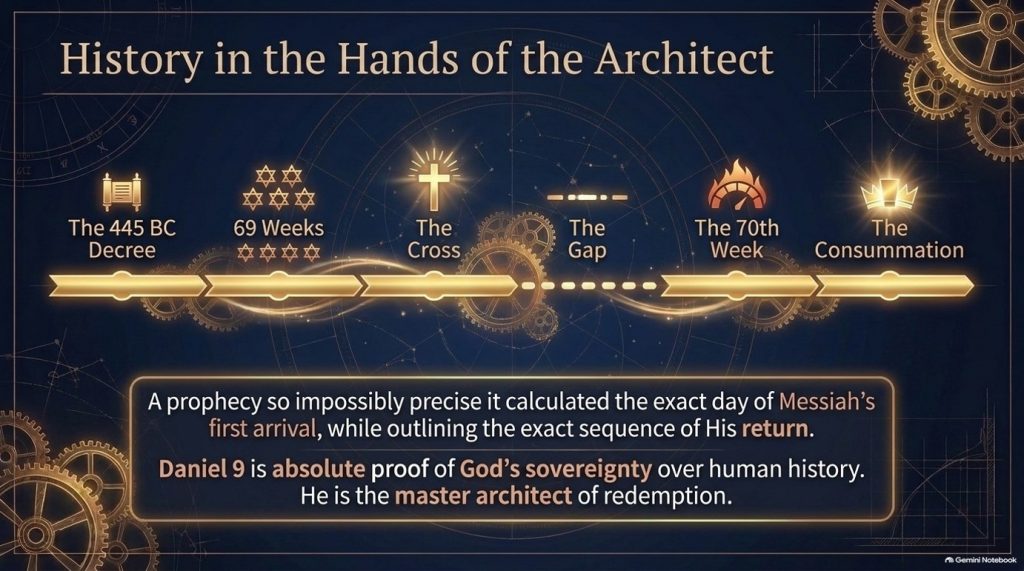
- The Period: 69 weeks (7 + 62) equals 483 years.
- The Mathematics: 483 years × 360 days = 173,880 days.
- The Result: Scholars such as Robert Anderson and J B Hickson have demonstrated that exactly 173,880 days from Artaxerxes’ decree lead to the Triumphal Entry of Jesus into Jerusalem.
“A prophecy so impossibly precise it calculated the exact day of Messiah’s first arrival while outlining the exact sequence of his return. Daniel 9 is absolute proof of God’s sovereignty over human history. He is the Master Architect of Redemption.”
5. The Parenthetical Age: The Prophetic Gap and the Church
A strategic “Gap” or “Parenthesis” is necessitated between the 69th and 70th weeks. The internal logic of the text proves this: the Messiah is “cut off” after the 69th week, and the destruction of the city (AD 70) occurs after the crucifixion, yet neither event is described as part of the final 70th week. Notably, the nearly 40-year interval between the Cross (c. AD 30-33) and the destruction of the Temple (AD 70) fits neither the 69-week nor the 70th-week descriptions, providing mathematical proof of a chronological parenthesis.
This interval represents the “Church Age.” While some critics suggest this renders the Church an “irrelevance,” Pauline revelation (Ephesians 3) identifies the Church as a “mystery”—a supreme objective of God’s purpose that was hidden in the Old Testament. During this parenthesis, God has paused His specific dealings with national Israel in order to gather a people from all nations, yet the 70th week remains a “fixed” decree that will resume once the “fullness of the Gentiles” is reached.
6. The 70th Week: Jacob’s Trouble and the Restoration of Israel
The final seven-year period, or “Jacob’s Trouble,” is the strategic instrument God uses to drive the nation of Israel toward a spiritual resolution. This era is characterized by a “covenant with many” and the “abomination of desolation.” Interestingly, Talmudic literature (Tractate Sanhedrin 97a) provides a striking parallel to the conditions of this era, describing a generation where “the face of the generation is like the face of a dog,” arrogance proliferates, the “cost of living” becomes corruptive and Israel loses all support while being under extreme persecution—conditions that drive the people to their lowest point ever.
The restoration process follows a specific four-stage trajectory (outlined in Deuteronomy 30):
- Return in Unbelief: The physical gathering of the Jewish people to the land for secular safety or nationalistic reasons. They are driven by the “Hunters and Fishers” (Jeremiah 16:16)—historical pressures and rising global anti-semitism.
- The Turning/Stretching: Extreme hardship in the land creates a “stretching” of the soul, as the nation reaches toward God in distress.
- National Conversion: In response to this stretching, God pours out the “Spirit of Supplication” (Zechariah 12:10). The “veil” mentioned in 2 Corinthians 3:16 is finally removed as the nation recognizes the Messiah they once rejected.
- Supernatural Gathering: Following the national conversion, the return of Christ triggers a final, angelic re-gathering of all Israel from all the nations where “not a hoof is left behind”. But the rebels are purged before entering the Kingdom (Jer. 30:11; Ezekiel 20:38).
7. Conclusion: The Watchman’s Mandate
The analytical examination of Daniel 9 reveals that the absolute mathematical precision of the first 69 weeks serves as a divine guarantee for the 70th. History is not drifting; it is being steered by the Architect. While we cannot know the “day or the hour,” the fulfilment of these “times and seasons” is intended to produce a posture of holiness and godly living.
The “So What?” of this commentary is the “Watchman’s Mandate.” Daniel did not merely treat prophecy as a mathematical curiosity; his discovery of the timeline drove him to intercession and repentance on behalf of his nation. We are called to mirror this posture—to be “ahead of the curve” in prayer and to live on the “tiptoe of expectation.” As the shadows of the 70th week lengthen across the global stage, the mandate for the believer is clear: to stand as a watchman who understands the Master Architect is about to complete His greatest work, ushering in the return of the King.